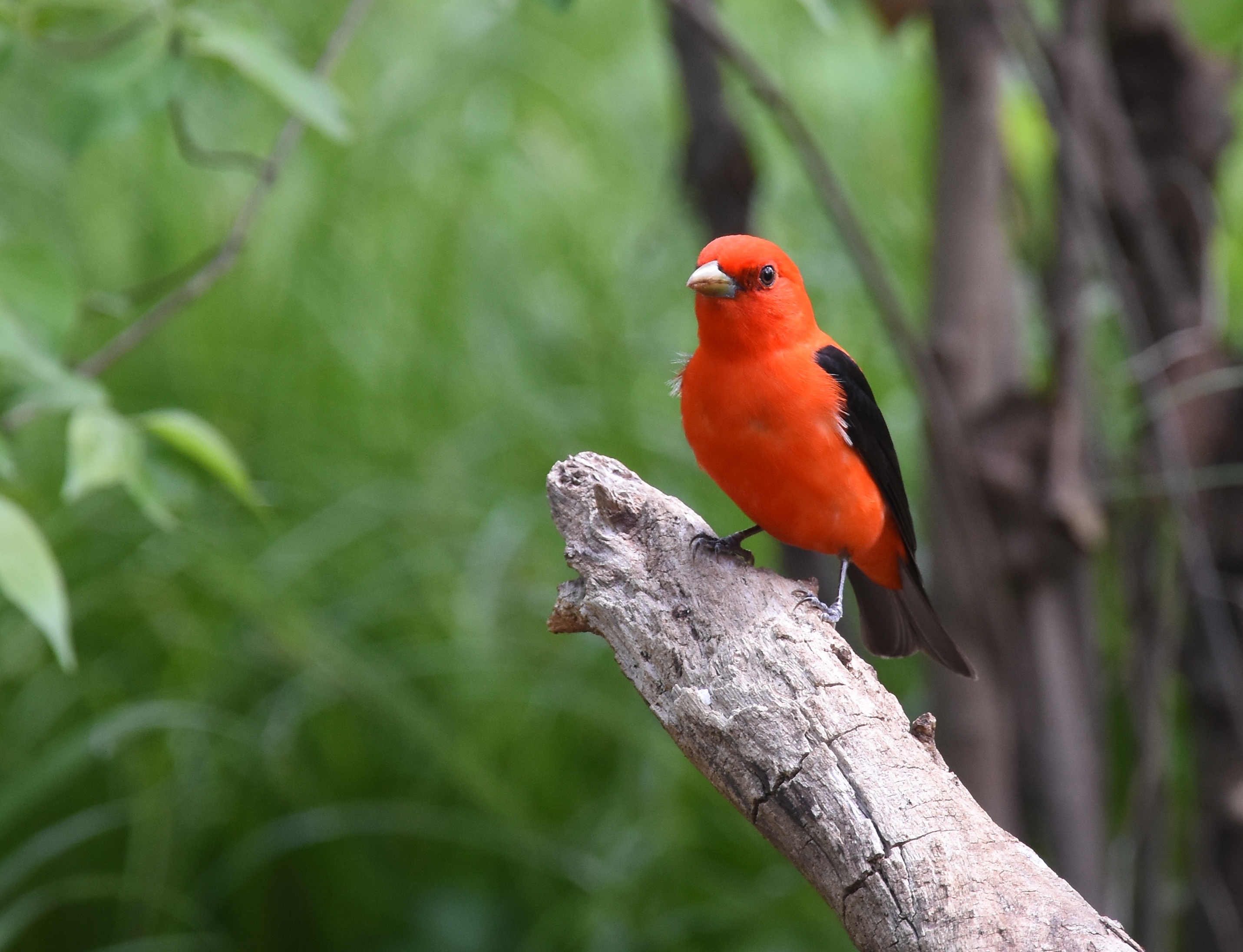
The Scarlet Tanager has lost over 30% of its population since 1970. Our eastern forest habitat restoration program targets the very breeding grounds this species depends upon — from the Appalachians to the boreal forests of Canada.
Through targeted land acquisition, sustainable forestry partnerships, and community-based monitoring, we are working to ensure that future generations may still witness the flash of crimson against summer-green leaves.
The Scope of the Decline
According to data from the North American Breeding Bird Survey, Scarlet Tanager populations have declined by approximately 14% across their range since 1966, with steeper losses in the northeastern United States and parts of the Upper Midwest. When combined with range contraction and localized extirpation from fragmented forests, the overall population reduction since 1970 exceeds 30% — a threshold that places the species on a trajectory toward vulnerability.
The primary driver of this decline is habitat loss. Scarlet Tanagers are interior forest specialists, requiring large, contiguous tracts of mature deciduous and mixed forest for successful breeding. As eastern forests have been fragmented by development, agriculture, and resource extraction, the species has struggled to find suitable nesting sites. Research consistently shows that tanager reproductive success drops dramatically in forests smaller than 250 acres, and nests located near forest edges face significantly higher predation rates from raccoons, crows, and domestic cats.
"The Scarlet Tanager is a sentinel species for the health of eastern forests. Its decline is not merely a loss of beauty — it is a warning signal that the ecosystems we depend upon are fraying at the edges."— Dr. Eleanor Whitmore, Director of Forest Bird Conservation, The Avian Society
Climate Change and Migration Pressures
Climate change compounds the challenges facing Scarlet Tanagers in ways that researchers are only beginning to fully understand. Warmer springs have altered the phenology of eastern forests, causing leaf-out to occur earlier and insect emergence to shift out of sync with tanager arrival from South American wintering grounds. This ecological mismatch — known as trophic asynchrony — means that tanagers may arrive on the breeding grounds to find that the peak abundance of caterpillars, their primary food source during nesting, has already passed.
On the wintering grounds in the Andes foothills of Bolivia, Ecuador, Peru, and Colombia, Scarlet Tanagers face additional threats from deforestation for coffee and coca cultivation. The species depends upon humid montane forest between 1,000 and 2,500 meters elevation — precisely the zone where agricultural expansion is most intense. Conservation efforts must therefore span the full annual cycle, protecting not only breeding habitat in North America but also critical wintering areas in the Neotropics.
Our Conservation Response
The Avian Society has launched a multi-pronged initiative to address Scarlet Tanager decline across its entire range. Our Eastern Forest Restoration Program has acquired or secured conservation easements on more than 12,000 acres of critical breeding habitat in the Appalachians, the Piedmont, and the Great Lakes region. These acquisitions prioritize forest interior habitat, creating and expanding contiguous blocks large enough to support viable tanager populations.
In partnership with the U.S. Forest Service and private landowners, we are promoting sustainable forestry practices that maintain forest canopy structure while allowing for selective timber harvest. Research has shown that even-aged clearcutting eliminates tanager habitat for decades, whereas carefully planned selective harvests can preserve breeding territories and accelerate forest recovery. Our certification program now covers more than 45,000 acres of working forest in the central Appalachians.
Community science plays an essential role in our monitoring efforts. The Scarlet Tanager Watch program trains volunteer observers to conduct point counts and nest surveys across the breeding range. In 2025, over 3,200 volunteers contributed data from 847 survey routes, building one of the most detailed datasets on tanager population trends ever assembled. This information directly informs our land acquisition priorities and allows us to measure the effectiveness of our conservation actions in real time.
What the Future Holds
There is reason for cautious optimism. Where habitat is protected and restored, Scarlet Tanager populations show signs of stabilization and, in some areas, modest recovery. At our Shenandoah Valley Sanctuary, tanager breeding density has increased by 22% over the past decade following reforestation of former pastureland. Similar results are emerging from our partnership sites in the Pennsylvania Highlands and the Adirondack foothills.
Yet the challenges remain formidable. Without continued investment in forest conservation, climate adaptation, and international cooperation on wintering ground protection, the Scarlet Tanager's decline may accelerate rather than reverse. The next decade will be decisive. We invite you to join us in this work — through membership, volunteer participation, or direct support of our land acquisition fund.
The flash of crimson in a summer forest is not merely a pleasure for birdwatchers. It is a sign that the ancient partnership between birds and forests remains intact. We have the knowledge and the tools to keep that partnership alive. What we need now is the collective will.